
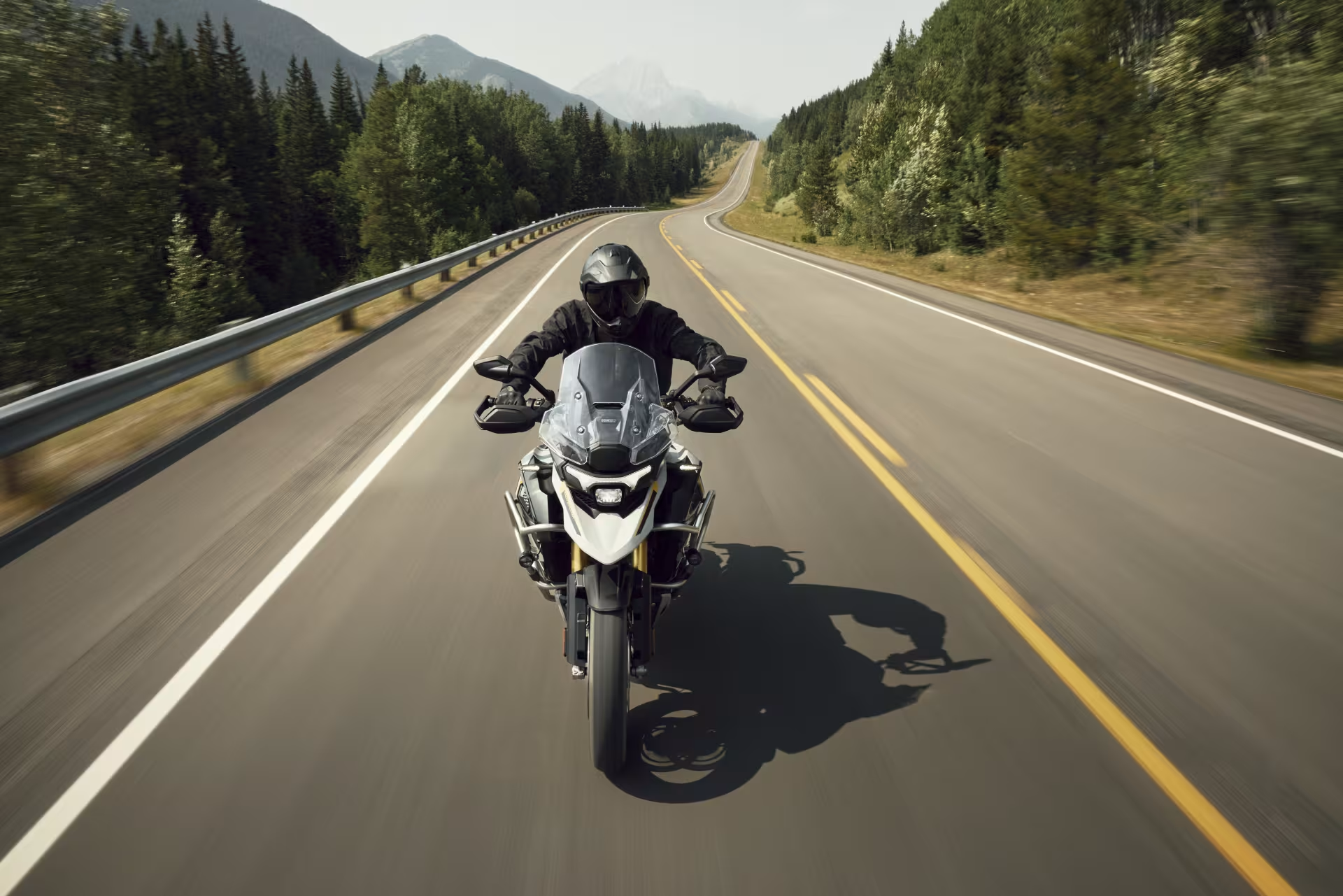
Triumph Reveals Its Most Advanced Tiger 1200 Yet
More power, improved handling and new rider-focused technology for Triumph’s flagship adventure bike.
Triumph has unveiled a thoroughly revised Tiger 1200 range, bringing increased engine performance, improved refinement, updated chassis dynamics and a significant expansion of its rider assistance and connectivity technology.
The latest generation has been developed to make the large-capacity adventure motorcycle easier to manage at low speeds while retaining its long-distance touring ability and off-road versatility. Four versions will be available: the GT Pro, Rally Pro, GT Explorer and Rally Explorer.
Key changes include an upgraded 1200cc triple-cylinder engine producing 158 PS, revised suspension with an automatic seat-lowering function, a new 7-inch high-definition touchscreen and Bosch front and rear radar systems. Redesigned bodywork and a new adaptive LED projector headlight complete the updates.
More performance from the 1200cc triple
Triumph’s latest T-Plane triple-cylinder engine now develops 158 PS at 9,250 rpm, representing an increase of 8 PS over the previous version. More torque is available lower in the rev range, helping the Tiger 1200 deliver smoother progress at low speeds and improved control during slow manoeuvres.
Engine revisions include a redesigned cylinder head, updated pistons, lighter inlet and exhaust valves, more precise fuel injection and a freer-flowing exhaust system. These changes are intended to improve combustion efficiency and gas flow through the engine.
Triumph has also revised the first three gearbox ratios to make better use of the available torque. Updates to the crankshaft and balancer shaft optimise rotating mass, while revised camshaft profiles provide more progressive valve opening.
Further changes to the six-speed gearbox and shaft drive aim to reduce mechanical noise and improve the smoothness of gear changes, acceleration and deceleration.
The revised gearing and increased low-speed torque also reduce the motorcycle’s crawl speed by 6 km/h, giving riders greater control in traffic and during tight, low-speed manoeuvres.

Suspension designed for road and trail
All four Tiger 1200 models now use a 19-inch front wheel and 17-inch rear wheel, alongside 200mm of suspension travel at both ends. This replaces the Rally models’ previous 21-inch front wheel, 18-inch rear wheel and 220mm suspension travel, bringing a more road-focused balance to the entire range without removing its off-road capability.
The suspension system has been updated with SHOWA EERA HEIGHTFLEX® semi-active technology, which offers three independently selectable damping settings: Firm, Medium and Soft. Riders can adjust these through a dedicated suspension button without changing their other riding settings.
The system uses information from multiple sensors, including a six-axis Inertial Measurement Unit (IMU), to continuously adjust compression and rebound damping. This helps maintain control over uneven surfaces and under braking.
At the front, 49mm forks are paired with a rear monoshock featuring automatic self-levelling preload adjustment. This maintains the motorcycle’s ride height and geometry when carrying a rider alone, travelling with a passenger or loaded with luggage. A hydraulic secondary bump stop also provides additional control over more demanding terrain.
The lightweight chassis and Tri-Link swingarm remain part of the package. The swingarm incorporates the shaft drive within a rigid aluminium structure, helping provide stability and consistent handling feedback.
Braking is handled by Brembo Stylema® calipers, paired with a Magura HC1 radial master cylinder. Triumph Shift Assist is also included, allowing clutchless upshifts and downshifts through the six-speed gearbox.
Depending on the model, riders can choose from up to eight riding modes: Road, Rain, Eco, Sport, Off-road, two configurable Rider modes and Off-road Pro on Rally versions. Each mode adjusts settings including throttle response, ABS, traction control and engine braking. Off-road modes can now be selected while moving.
Automatic seat lowering for greater confidence
One of the most significant additions is the SHOWA EERA HEIGHTFLEX® automatic ride-height function, designed to make the Tiger 1200 easier to handle when coming to a stop.
Using hydraulically controlled semi-active suspension, the system monitors speed and braking before reducing rear suspension pressure as the motorcycle slows to a halt. This lowers the seat by 30mm, helping riders get their feet more firmly on the ground without sacrificing the commanding riding position when underway.
The system operates whether the motorcycle is carrying a solo rider, a passenger or luggage. Once the bike moves off, the suspension returns to its optimum ride height within seconds.
Further adjustments come from a two-position seat mechanism, offering 20mm of adjustment, and a new low seat that reduces the height by another 20mm. With the low seat fitted and the automatic lowering function active, seat height can be reduced to 790mm while stationary. The low seat is supplied as standard in selected markets and offered as an accessory in others.
The technology also introduces Centre Stand Assist. As the centre stand is deployed, the suspension temporarily increases preload, raising the rear of the motorcycle and reducing the effort needed to lift it onto the stand, including when the bike is fully loaded.
Improved comfort and long-distance practicality
Touring comfort remains central to the Tiger 1200’s design. Revised ergonomics and redesigned rider and passenger seats feature foam that is 10mm thicker than before, with spacious seating and comprehensive luggage options available across the range.
Heated seats for both rider and passenger, along with three-stage heated grips, are standard throughout the line-up.
Fuel capacity depends on the model. The GT Pro and Rally Pro retain 20-litre tanks, while the GT Explorer and Rally Explorer use larger 30-litre tanks for longer distances between fuel stops.
The shaft-drive system also reduces routine maintenance compared with a chain-driven final drive, eliminating the need for regular chain cleaning and adjustment.
A new touchscreen and expanded connectivity
The Tiger 1200 receives a Bosch 7-inch high-definition TFT touchscreen, bringing wireless Apple CarPlay® and Android Auto™ compatibility to the range. Riders can access supported navigation, music and messaging applications through the updated interface.
At speeds below 2 km/h, the display can be operated using the touchscreen. Once moving, riders can use the revised switchgear, while voice control is available through Siri for iPhone users and Google Gemini for Android Auto users. A compatible Bluetooth headset is required to access the full benefits of Apple CarPlay and Android Auto.
A waterproof phone compartment integrated into the top of the fuel tank provides a USB-C charging connection delivering up to 3A/15W. Airflow channels and an automatically controlled cooling fan help regulate the temperature of devices stored inside.
The display is designed for use in challenging conditions, with an IP6K9K dust and water resistance rating, optically bonded anti-glare glass and automatic brightness adjustment.

Adaptive lighting for night riding
The revised front end incorporates a compact adaptive LED projector headlight, which adjusts its lighting as the motorcycle leans into a corner.
Additional integrated LED elements illuminate sequentially at lean angles of 15 and 30 degrees, directing more light towards the inside of a bend. An electric motor also adjusts the beam level automatically to account for changes in suspension height.
A dedicated daytime running light maintains the Tiger’s recognisable lighting signature, while separate LED marker lights improve its visibility during the day. Backlit switchgear makes the controls easier to see in low-light conditions.
At the rear, multifunction LED units incorporate the indicators and tail lights, creating a cleaner appearance without a conventional central rear light.
Bosch radar brings a new generation of rider assistance
Front and rear radar technology developed in partnership with Bosch introduces a comprehensive suite of Advanced Rider Assistance Systems (ARAS). The features are designed to improve rider awareness and help identify potential hazards, while allowing riders to determine how individual functions support them.
Adaptive Cruise Control uses throttle and braking inputs to maintain a selected speed or following distance from the vehicle ahead. Riders can choose between Comfort and Dynamic responses, while Overtake Assist prepares for a passing manoeuvre when the indicator is activated and the blind spot is clear.
Curve Speed Control can reduce speed through longer turns when operating in Comfort mode. Group Ride Assist uses radar to maintain an appropriate gap based on speed and the position of motorcycles ahead. A separate Dynamic Cruise Control mode maintains the selected speed using the throttle, engine braking and brakes.
Additional front-radar functions include Riding Distance Assist, Emergency Brake Assist and Forward Collision Warning.
Riding Distance Assist helps prevent the motorcycle from getting too close to the vehicle in front by limiting acceleration and applying the brakes when necessary. Emergency Brake Assist can increase braking pressure if a potential collision is detected during heavy braking.
Forward Collision Warning provides an alert on the display. If the distance continues to close, the system follows this with a haptic pulse through the rear brake pedal.
The rear radar supports Blind Spot Assist, which monitors the rider’s blind zone and vehicles approaching rapidly from behind. Warnings are delivered through lights on the mirrors. Rear Distance Warning provides an additional alert when another vehicle is following too closely.
These functions work alongside the existing Optimised Cornering ABS and Traction Control systems. Both use wheel-speed data and information from the six-axis IMU to adjust braking pressure and engine torque according to speed and lean angle.
Sharper styling with a distinctive Tiger identity
The latest Tiger 1200 retains its familiar adventure-bike proportions, but revised bodywork gives it a more contemporary appearance.
Changes include a restyled fuel tank, redesigned radiator cowls and a revised beak and windscreen, creating a more muscular upper section and a cleaner front profile. The compact projector headlight incorporates the adaptive cornering function, while exposed frame sections reinforce the bike’s purposeful styling.
Wheel design remains one of the main visual differences between the GT and Rally variants. GT models use cast aluminium wheels, reflecting their more road-oriented character, while Rally versions feature side-laced spoked wheels for a tougher, more off-road-focused appearance.
Four models to suit different adventures
The updated range consists of the Tiger 1200 GT Pro, Rally Pro, GT Explorer and Rally Explorer. All share the revised engine, suspension and core technology, with differences in fuel capacity, wheels and equipment helping distinguish each version.
The GT Pro and GT Explorer use cast aluminium wheels, while the Rally Pro and Rally Explorer feature side-laced spoked wheels. Both Rally models also receive Off-road Pro riding mode, engine protection and an adjustable folding brake pedal.
The Explorer models have 30-litre fuel tanks, compared with the 20-litre tanks on the Pro versions. They also include a Tyre Pressure Monitoring System, dedicated lower engine bars and handlebars positioned 10mm higher and 10mm wider than those on the Pro models. The Rally Explorer additionally features upper engine bars.
Colour options vary across the range:
- Tiger 1200 GT Pro: Sapphire Black or Aluminium Silver/Pacific Blue.
- Tiger 1200 GT Explorer: Aluminium Silver/Pacific Blue or Granite.
- Tiger 1200 Rally Pro: Matt Khaki Green or Ash Grey.
- Tiger 1200 Rally Explorer: Ash Grey/Sapphire Black or Matt Khaki Green.
Touring equipment and accessories
Triumph has also developed a range of genuine accessories to help owners tailor the Tiger 1200 for touring, comfort, protection and technology.
The Evo luggage system, created in partnership with GIVI, is designed to increase carrying capacity while preserving confident handling when the motorcycle is fully loaded.
A new 58-litre twin-helmet top box joins the existing 42-litre option. Both are made from durable aluminium and available in silver or anodised black, with an optional backrest pad for additional passenger comfort.
Matching panniers feature easy-access openings and can be fitted with optional waterproof inner bags. Trekker touring luggage is also available.
For riders planning extended trips, the combination of a low-maintenance shaft drive, a 10,000-mile (16,000km) service interval and Triumph’s international dealer network is intended to make long-distance ownership more straightforward.
Triumph: a major step forward for the Tiger
Triumph Motorcycles Chief Product Officer Steve Sargent said the latest updates represented a significant change for the Tiger 1200, with the development programme focused on performance, accessibility and rider-friendly technology.
He highlighted the company’s work with its technology partners, including the implementation of SHOWA EERA HEIGHTFLEX® and the development of motorcycle-specific Apple CarPlay and Android Auto functionality. Triumph also worked closely with Bosch to adapt radar technology to its motorcycles.
Sargent said the revised chassis and engine refinements were intended to deliver a noticeable difference on the road, alongside the expanded technology package.
UK prices and availability
The updated Triumph Tiger 1200 range is available to order now, with motorcycles expected to arrive in dealerships from December 2026.
UK prices start at £18,295 for the GT Pro and rise to £20,575 for the Rally Explorer.
- Tiger 1200 GT Pro: £18,295
- Tiger 1200 Rally Pro: £18,995
- Tiger 1200 GT Explorer: £19,875
- Tiger 1200 Rally Explorer: £20,575
For further information, visit Triumph Motorcycles UK.